
Laos Under French Colonial Rule

In the process of writing my first historical novel, Across the Mekong River, I became deeply immersed in the history of Laos. The more I read, the more I wanted to know. I loved finding black and white photos from the early French colonial days on through the post-WWII era. The French occupied Laos for fifty years, playing a critical role in shaping the future of the people and country. This resulted in two wars—one in the early 1950s in the fight for independence from France, and another in the 1960s and 70s as Western democracies fought unsuccessfully to stop communism from taking over the Indochinese countries (the Vietnam War).


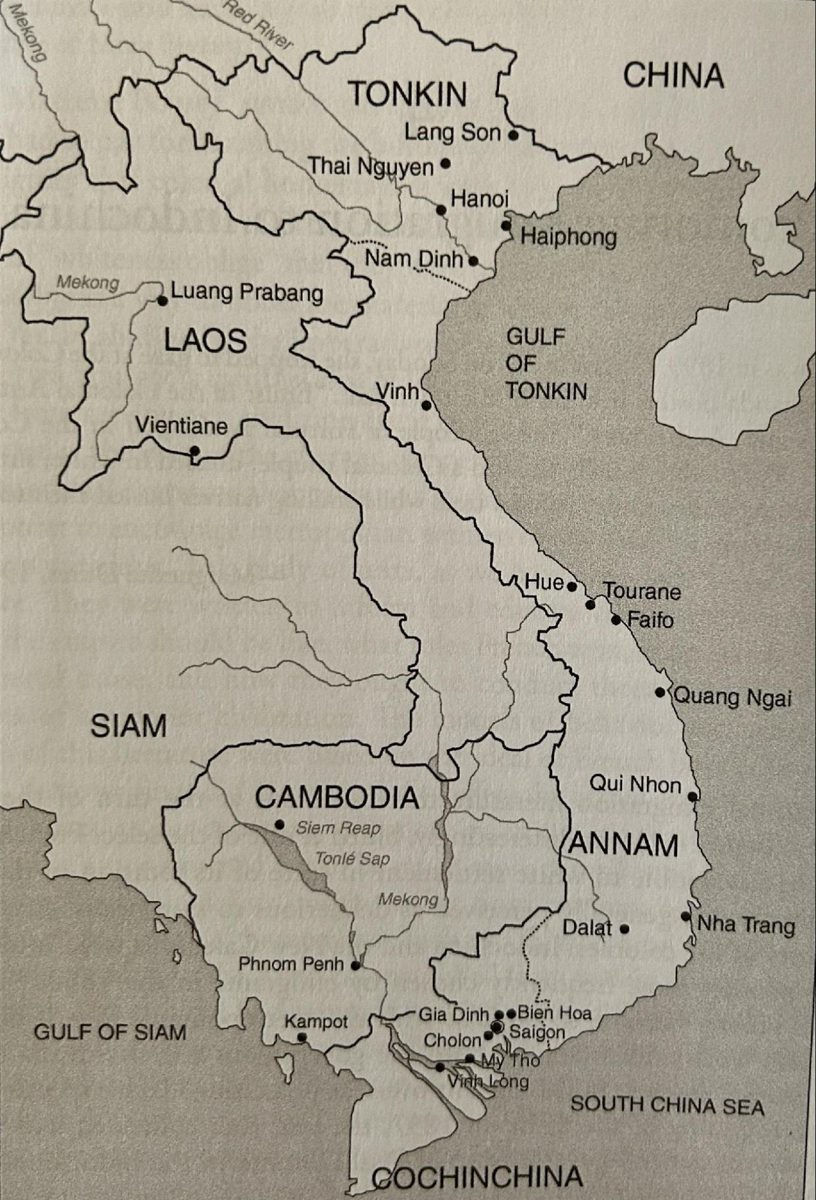
From its earliest days of feudal kingdoms to the arrival of the French, Laos had remained a little known, remote land. The French took control over all of Vietnam and Cambodia by 1887, dividing Vietnam into three colonies: Tonkin, Annam, and Cochinchina. Then, worried about the dominance of Siam (Thailand) over Laos, dating from the late 1700s, France decided to acquire it as well. In 1893, they sailed French war ships to Bangkok, pointed their guns at the royal palace, and forced the Siamese to cede Laos.
When the French took over, Laos was not a single country but three kingdoms. Only the Kingdom of Luang Prabang in the north was preserved and allowed some autonomy with French oversight. The kingdoms of Vientiane, in central Laos, and Champasak, in the south, fell under direct French rule.
One of the justifications the French gave for colonization was their mission civilisatrice, or civilizing mission. A prominent French statesman, Jules Ferry, proudly proclaimed, “The superior races have the duty of civilizing the inferior races.” France wanted to bring Western morals, religion, and development to “improve” these countries and raise their standard of living. Of course, they were also extremely interested in extracting as much wealth as possible, exploiting the natural resources and cheap labor force of colonial people. Most French considered the Lao people inferior, best suited as servants or, for the men, as mistresses. This attitude extended to the métis, despite the fact that they were half-French.
From the beginning, the French presence in Laos was much lighter than in the other colonies of Indochina. In 1931, there were only a few hundred government officials and soldiers stationed throughout the country and a small civilian population. Laos was viewed more as a buffer from Siam than a place for commercial development. There were fewer natural resources and a lack of an adequate labor force. The vast majority of Lao people were rural, subsistence farmers without any education or training. Unlike in Vietnam and Cambodia, French rule in Laos met with little resistance. There were only a few isolated rebellions in Hmong communities in the mountains.
Vientiane, the capital of French colonial Laos, had the largest French population, but this was only around 50 residents in 1931. The French colons, as they were called, lived apart from the Lao, with separate French schools for their children and houses in their own neighborhoods. They built a clubhouse with a tennis court where they spent their free time among their own. The only Lao citizens that the French socialized with were royalty from the Kingdom of Luang Prabang and a small number of wealthy, educated Lao.

When I first decided to write a novel set in the colonial period, I had not decided on the focus of the story. After perusing the bookshelves on Lao history at the U.C. Davis library, I found my answer—a recently published book called The Uprooted: Race, Children, and Imperialism in French Indochina, 1890-1980 by Christina Elizabeth Firpo, a professor at Cal Poly State University. For the first time, this book revealed the sad and misguided French policy regarding the métis and its long-term consequences.

Many French men abandoned their mistresses and métis children when they returned to France. As the number of métis grew, the colonial government decided to remove these children from their Lao mothers and place them in French orphanages within Laos. The children were not allowed to learn the Lao language or local culture. They often hid the location of the children from their Lao families and, in some cases, separated siblings without telling them where they were located. The idea was to turn métis children into model French citizens, who would support the colonial government. But in reality, these children faced terrible prejudice and discrimination. Many French called them sale (dirty) métis, because their mothers were considered immoral women, unmarried mistresses of French men, who had given birth to their children out of wedlock.
This was the story I needed to tell. And so, I wrote When the Tamarind Tree Blooms.
Comments